Study 03 - Motivation Design
The vision board wasn’t enough.
Because motivation needed feedback, not just reminders.
Role
Research-led Product/UX Designer
Scope
Research · IA · UI · Prototyping
Team
Solo (personal project)
Platforms
iOS / Android
Timeline
12.2024–04.2025
Status
Prototype
TL;DR
Vision can spark motivation. Sustain likely needs post-action feedback.
Cross-case signal
Seen in Case 1 + dietitian interviews:
People act when motivation is available—not when information is.
Progress (I1–I3)
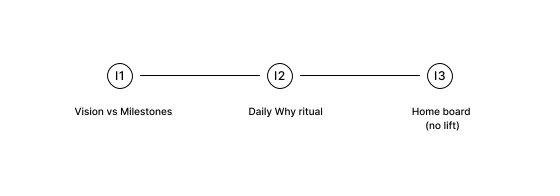
Vision & Milestones (I1)→ Daily “Why” (I2)→ Vision board (I3)
Highlights (n=5)
Feedback gap (5/5)
Self-authored works (4/5)
Focus
Sustain needs feedback plus guided Vision-to-use linkage.
Next bet (concept only)
Feedback loops as the next hook: level-ups, missions, check-ins.
Evidence signals (n=5)
Qualitative test signal, not a KPI.
I2 feature-Daily "Why" Ritual
view signals
Perceived meaning signal (n=5)
Back to I2 "Why" ritual
Tension
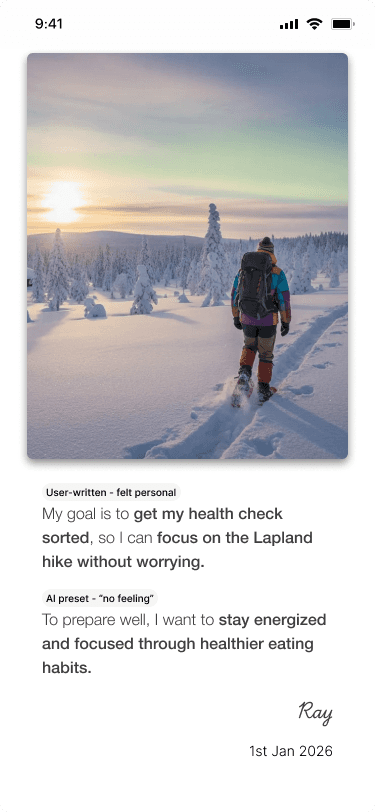
Choice and meaning (I2) helped people start, but sustain remained unclear.
What I learned from early tests (n=5)
Self-chosen Vision/Sentences (4/5):
Motivation rose only when people authored the Vision; presets felt decided.
Numbers are double-edged:
Motivated some users, pressured others depending on stage.
Daily “Why” ritual (+3/5):
Increased emotional buy-in, but the lift was context-dependent.
Bridge:
I brought the Vision + Why back to Home to see if an integrated surface could sustain motivation.
What I learned
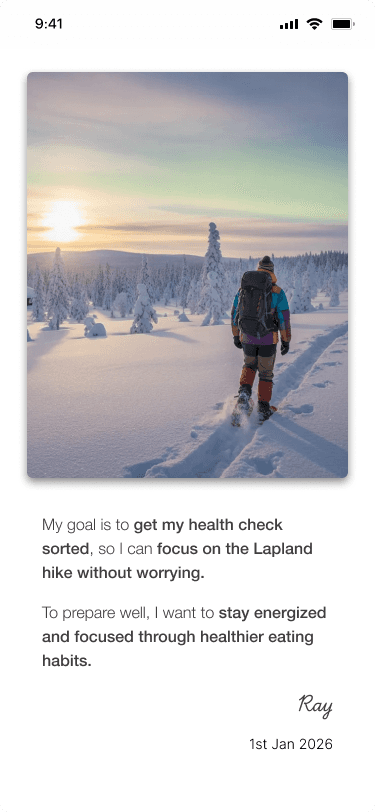
The Vision board (I3) showed no lift beyond the daily Why(I2)—feedback was the missing piece.
What the comparison revealed (n=5)
No lift (I3 vs I2):
The integrated Vision board did not increase motivation beyond the daily Why ritual
Feedback gap (5/5):
Without post-action feedback, the board felt like a static reminder, not progress.
Reframe
The question is not how to show motivation, it is what reinforces it after use.
I3 feature-Adjustable Vision Board (On Home)
Compare with I2 (Why-only)
Back to I2 "Why" ritual
What worked:
Ownership created meaning
4/5
What didn’t
Board ≠ sustain
no lift
Next bet:
Shift to post-action feedback
Next
Direction Shift
Stop polishing the Vision board. Build feedback after action.
Keep for now
Decision:
Self-authored Vision (“why I use this”) over presets.
Anchor:
Daily Why starts the loop; feedback sustains it.
Next bet (concept only):
Design post-action feedback (level-ups, missions, check-ins). Turn progress into rewards to sustain momentum.
Takeaway
If motivation fades over time, what should the product do next?
Takeaway:
Vision sparks motivation, but sustain likely needs feedback after action.
Reflection:
Motivation shifts by stage. What helps at the start is not what keeps it going.
Next (short term):
Design a “mission completed” feedback moment (micro-motion + reward).
Long term:
Define a gamification progression system (levels/achievements) that reflects effort without KPI pressure.
Cross-case hypothesis (not a change yet):
Food Diary could plug into the progression system as a milestone signal, not a standalone record.
Case Study 3 - Evidence pack
Optional deep dive below.
How did I test motivation shifts across iterations?
Research Snapshot
What actually sparks motivation?
Iteration 1
Can a tiny ritual turn intent into commitment?
Iteration 2
If motivation shifts by stage, should the board adapt too?
Iteration 3
What could distort these signals?
Limitations & Bias
Deep Dive
Study 00 Overview
Study 01 Product Strategy
Study 02 Next-Step Guidance
©2025 Ya-Ning Chang. All Rights Reserved.
Study 03 - Motivation Design
The vision board wasn’t enough.
Because motivation needed feedback, not just reminders.
Role
Research-led Product/UX Designer
Scope
Research · IA · UI · Prototyping
Team
Solo (personal project)
Platforms
iOS / Android
Timeline
12.2024–04.2025
Status
Prototype
TL;DR
Vision can spark motivation. Sustain likely needs post-action feedback.
Cross-case signal
Seen in Case 1 + dietitian interviews:
People act when motivation is available—not when information is.
Progress (I1–I3)
Vision & Milestones (I1)→ Daily “Why” (I2)→ Vision board (I3)
Highlights (n=5)
Feedback gap (5/5)
Self-authored works (4/5)
Focus
Sustain needs feedback plus guided Vision-to-use linkage.
Next bet (concept only)
Feedback loops as the next hook: level-ups, missions, check-ins.
Evidence signals (n=5)
Qualitative test signal, not a KPI.
I2 feature-Daily "Why" Ritual
view signals
Perceived meaning signal (n=5)
Back to I2 "Why" ritual
Tension
Choice and meaning (I2) helped people start, but sustain remained unclear.
What I learned from early tests (n=5)
Self-chosen Vision/Sentences (4/5):
Motivation rose only when people authored the Vision; presets felt decided.
Numbers are double-edged:
Motivated some users, pressured others depending on stage.
Daily “Why” ritual (+3/5):
Increased emotional buy-in, but the lift was context-dependent.
Bridge:
I brought the Vision + Why back to Home to see if an integrated surface could sustain motivation.
What I learned
The Vision board (I3) showed no lift beyond the daily Why(I2)—feedback was the missing piece.
What the comparison revealed (n=5)
No lift (I3 vs I2):
The integrated Vision board did not increase motivation beyond the daily Why ritual
Feedback gap (5/5):
Without post-action feedback, the board felt like a static reminder, not progress.
Reframe
The question is not how to show motivation, it is what reinforces it after use.
I3 feature-Adjustable Vision Board (On Home)
Compare with I2 (Why-only)
Back to I2 "Why" ritual
What worked:
Ownership created meaning
4/5
What didn’t
Board ≠ sustain
no lift
Next bet:
Shift to post-action feedback
Next
Direction Shift
Stop polishing the Vision board. Build feedback after action.
Keep for now
Decision:
Self-authored Vision (“why I use this”) over presets.
Anchor:
Daily Why starts the loop; feedback sustains it.
Next bet (concept only):
Design post-action feedback (level-ups, missions, check-ins). Turn progress into rewards to sustain momentum.
Takeaway
If motivation fades over time, what should the product do next?
Takeaway:
Vision sparks motivation, but sustain likely needs feedback after action.
Reflection:
Motivation shifts by stage. What helps at the start is not what keeps it going.
Next (short term):
Design a “mission completed” feedback moment (micro-motion + reward).
Long term:
Define a gamification progression system (levels/achievements) that reflects effort without KPI pressure.
Cross-case hypothesis (not a change yet):
Food Diary could plug into the progression system as a milestone signal, not a standalone record.
Case Study 3 - Evidence pack
Optional deep dive below.
How did I test motivation shifts across iterations?
Method
What actually sparks motivation?
Iteration-1
Can a tiny ritual turn intent into commitment?
Iteration-2
If motivation shifts by stage, should the board adapt too?
Iteration-3
What could distort these signals?
Limitations & Bias
Deep Dive
Study 00 Overview
Study 01 Product Strategy
Study 02 Next-Step Guidance
©2025 Ya-Ning Chang. All Rights Reserved.