Role
Research-led Product/UX Designer
Platforms
iOS / Android
Timeline
12.2024–04.2025
Status
Prototype
TL;DR
What I tested
Whether supplement support was meaningful enough to anchor the product?
What I found: Weak anchor for long-term use
Use was too low-frequency and too trust-heavy.
New lens
I re-synthesized the same interviews through a participant-led lens
Action gap
The real issue wasn’t knowledge, but what kept breaking between intention and action.
Impact: New direction
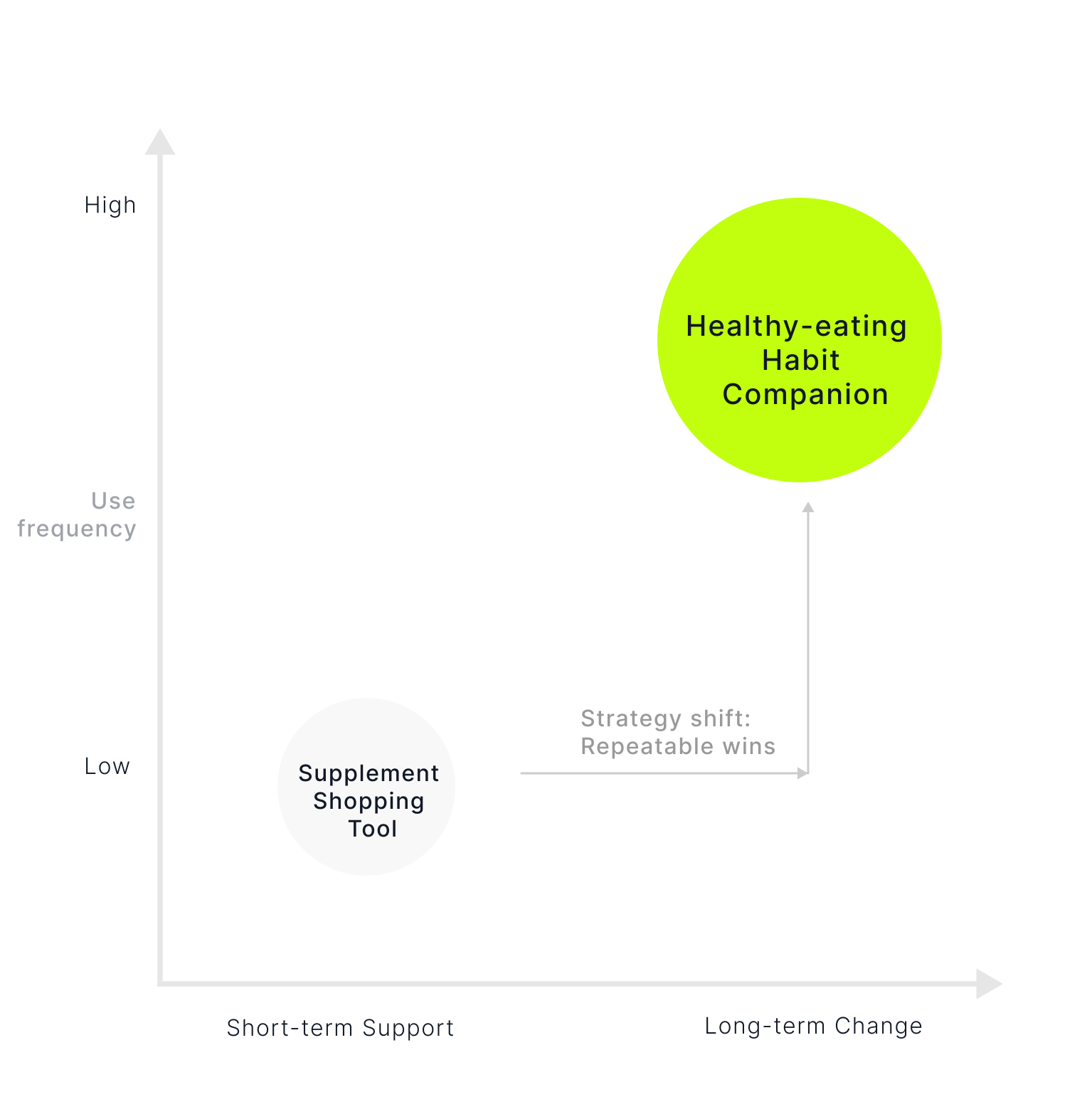
Shift toward repeatable healthy-eating action, not supplement optimization
Background & Context
Starting point
Initial framing
•
•
•
Method
1:1 semi-structured interviews (n=5)
Scope
Early-stage concept positioning
Output
Direction recommendation (not final product validation)
Round 1 · Supplement Lens
Why initial concept failed
Under the supplement lens, the concept was too weak to anchor long-term use.
First pass
I ran 5 semi-structured interviews using supplement selection as the entry point. Participants repeatedly redirected the conversation toward food, movement, and everyday follow-through.
What I heard
-- Education
-- IT Engineer
-- Designer
Round 1 Patterns (from interviews; n=5)
Occasional support
Supplements were situational, not a daily anchor.
Trust fatigue
People felt they had to verify what to believe.
Health foundation
Food and movement came up more consistently than supplements.
Competitor reality (Round 1)
Crowded space
A supplement-first product would require high credibility, a strong content base, and long trust-building — while still serving low-frequency behavior.
Recommendation (Round 1):
Shift to long-term anchor
The supplement-helper position was too weak to serve as the product’s long-term anchor.
Re-analysis
Same data. New framing.
The first round (supplement lens + competitor audit) exposed a critical mismatch:
Trust fatigue was too high;
Purchase frequency was too low → A new app could not compete.
Same interviews, different lens
I returned to the exact same 5 transcripts and deliberately changed my synthesis framework.
First pass
•
•
•
Second pass
•
•
•
The interviews stayed the same. The product question changed.
Not a contradiction
One participant still saw a supplement market, but through TV shopping and phone orders — reinforcing the mismatch for an app-based solution.
Strong enough signal
Even with n=5, repeated unprompted redirects and follow-up depth made the pattern hard to ignore.
What emerged
Clearer barriers and opportunities in long-term healthy-eating behavior.
Decision rule
I followed repeated redirects, recurring barriers, and what participants returned to without prompting.
Repeated signals across participants made the original framing too weak to hold.
Round 2 Synthesis
Action gap
The real problem wasn’t knowing. It was sustaining.
Once I re-read the interviews through a participant-led lens, a different problem became visible: not lack of knowledge, but what kept breaking between intention and action.
Healthy intention
Wanted to eat healthier • Believed food mattered more than supplements.
Friction
Tired after work • Unclear next step • Motivation fading after support ended.
Breakdown
Knowing ≠ doing • Tracking felt heavy • Action didn’t repeat.
Opportunity
Lower-friction support • Doable next steps • Repeatable daily action.
More information wasn’t the answer. More doable action was.
Participant signals
-- Clinical pharmacist
-- Education
-- Doctoral Researcher
Round 2 Patterns (from interviews; n=5)
Recurring patterns
Knowing ≠ Doing
Knowledge did not reliably turn into repeatable action.
Low-energy next step
Wanted something doable when tired.
Difficult to sustain***
For some, heavy tracking weakened meal enjoyment.
Competitor reality (Round 2)
Lower-friction support
The opportunity was not comprehensive tracking or medical-style advice, but lighter support for repeatable daily action.
Recommendation (Round 2)
Habit support
Shift from supplement support to healthy-eating habit support built around repeatable daily action.
New position
From “Supplement Optimization Helper” → To “Habit Companion” focused on making healthy eating feel achievable, enjoyable, and sustainable.
Impact
What shifted
Daily use shift
The direction changed from one-off purchase logic to long-term daily use.
Clearer market differentiation
The concept moved away from the crowded tracking / medical space toward enjoyment and low-energy moments.
Decision status
Clear vs open
Research-backed
•
•
•
Still a bet
•
•
•
Decision input
Decision input for the team
This study narrowed what to stop, pursue, and validate next.
What changed (Before/ After)
Supplement optimization
Health support
Repeatable healthy eating action
Health support
Low-frequency purchase behavior
Repeatable daily use potential
Trust-heavy information problem
Action and follow-through problem
Ruled out
•
•
•
Recommended direction
•
•
•
Open questions
•
•
•
Validation focus
Next bet
The study was strong enough to change direction, but not to finalize the concept.
1. Entry point
Which daily action feels most doable to start with?
2. Reinforcement
What kind of feedback helps people come back without creating pressure?
3. Boundary
How well does this direction hold across different eating contexts and motivation levels?
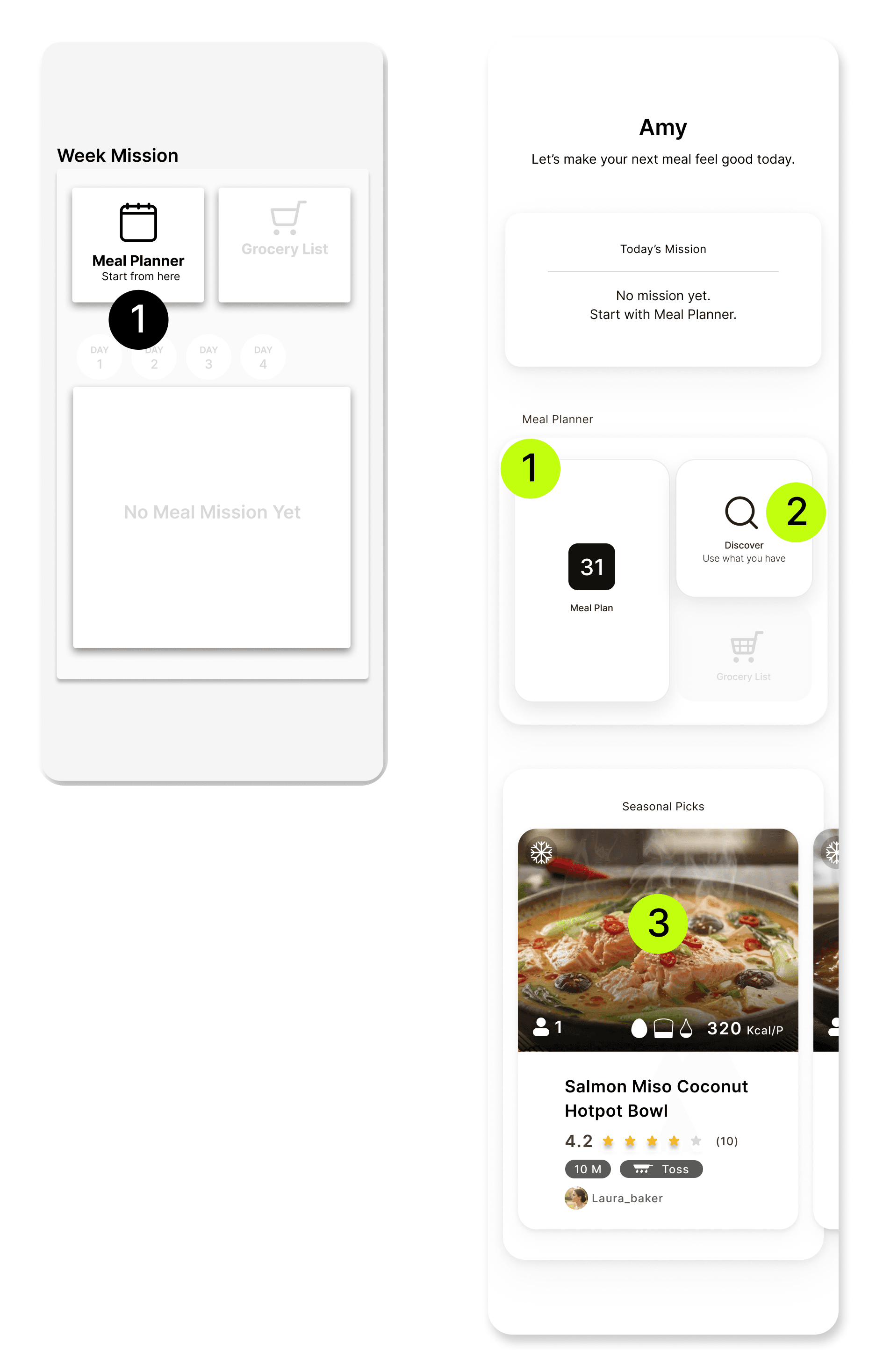
Rather than designing the full product at once, I translated the research into a first testable loop: a lightweight path from planning to immediate action.
This study ends at the point where research became a concept direction.
Study 2 and 3 examine how that direction was further tested through entry-point clarity and motivation support.
Concept direction
Make action feel doable
Research-enabled concept direction
Meal Planner → Mission preview
Built MVP
Food Diary
Planned
Retention impact
Open bet
Validation highlights
Case 2 → Make it doable (core flow friction)
Case 3 → Make it meaningful (motivation triggers)
Concept direction
From insight to first loop
Research-enabled concept direction
Insight
Users needed a next step that still felt doable in low-energy moments.
Direction
Prioritize support for action and follow-through, not more information.
First loop
Meal Planner → Mission preview → Action
Case 3 → Make it meaningful (motivation triggers)
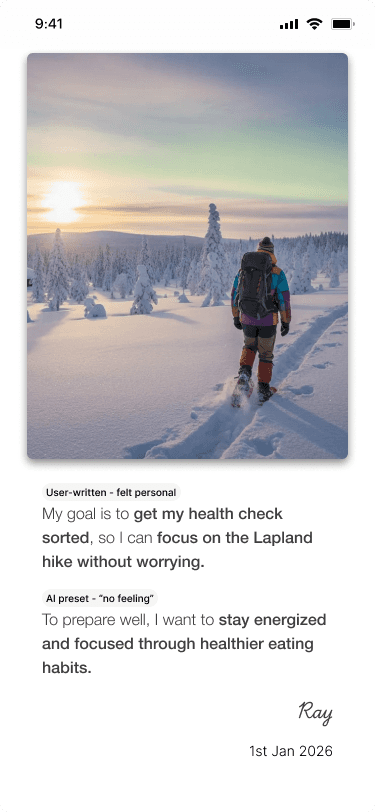
Case Study 1 - Evidence pack
Deeper reads
Takeaway
I pivoted to a learning-by-doing habit companion—designed for enjoyable, repeatable eating.
What this project taught me:
• Supplements were occasional support. Daily food + movement drove real change. • Repeatable actions — not perfect plans — became the core strategy.
Positioning guardrail:
A healthy-eating habit companion, not a cooking app or a medical diagnosis tool.
Next (early roadmap):
Validate the MVP core path: Meal Planner → Mission preview, so users can decide the next step in minutes. (Validation lives in Case 2 + Case 3.)
Update (after Case 3): How the concept evolved
Later, Case 3 suggested sustain needs post-action feedback, so Food Diary should become a milestone signal inside a progression system — not a standalone record.
Deep Dive